
In an effort to improve the outcome of couples therapy, Andrew Christensen of UCLA, the late Neil Jacobson of the University of Washington, and later Brian Doss of the University of Miami developed Integrative Behavioral Couples Therapy (IBCT), which integrates strategies for promoting acceptance in couples with traditional behavioral strategies for promoting change.
"Acceptance work" focuses on turning problems into vehicles for promoting intimacy and increasing couples' tolerance for what they see as each other's negative behavior. As couples let go of the struggle to change each other, change often occurs in response to natural contingencies. Several clinical trials have demonstrated the effectiveness of IBCT. It has been adopted since 2010 by the United States Department of Veterans Affairs (VA) as one of its empirically supported treatments for couples, with positive results.
IBCT has also been adapted by Brian Doss and Andrew Christensen into an online program (www.OurRelationship.com), recent clinical trials of which have shown the effectiveness of this program.
In this two-day workshop, Andrew Christensen, Brian Doss will provide the theoretical foundation, assessment strategies, treatment strategies, and empirical support for Integrative Behavioral Couples Therapy (IBCT). The workshop will illustrate assessment and treatment techniques through videotaped examples of couples in treatment and will provide role-play experiences in implementing these techniques. The first day of the workshop will provide the theoretical and empirical basis for IBCT, review couples assessment in IBCT, describe and illustrate assessment and feedback sessions in IBCT, and provide an overview of treatment. There will be role-play experiences in which audience members can rehearse these case formulation, evaluation, and feedback procedures. For the role-play experiences, the audience will be divided into small groups of three or four participants, along with a coach with one person playing the role of the therapist and the other two the couple, with members switching roles for the different role-play experiences. We will preview the role-playing exercises and summarize the role-playing exercises in the larger group, but we will divide into smaller groups to better guide the learning of the role-playing exercises.
On the second day of the workshop, we will describe and illustrate IBCT treatment strategies and describe special issues in couples therapy, such as infidelity. Treatment strategies will be illustrated with video examples of couples in treatment. As on the first day, there will be a series of role-play exercises in which participants will practice these treatment strategies in groups. The last stage of the workshop will be with therapist Betty Shadish, who will present how IBCT works with high-conflict couples.
General Objective:
Learn the IBCT protocol
Specific objectives:
1. Describe the theoretical and empirical basis of IBCT
2. Differentiating IBCT from traditional and cognitive-behavioral couples therapy
3. Conduct a clinical formulation in IBCT through a DEEP analysis
4. Describe and practice assessment methods, clinical formulation and feedback strategies in IBCT
5. Describe and practice IBCT (Acceptance and Change) treatment strategies
6. Learn strategies for working with high-conflict couples
Expository classes, Video Presentation and Discussion of clinical cases, Training of strategies in small groups with guidance from a trained supervisor
It will be an incredible opportunity to see the creators of the approach working together
There will be supervisors trained to work in small groups, helping with better learning
There will be supervisors who speak Portuguese and supervisors who speak Spanish
At the end there will be extra content with another experienced teacher and clinician on how IBCT works with very conflicting couples
This workshop is the first step towards achieving Official Certification in IBCT
Mara Lins
SUPPORT:




¡Hola! Signing up for the event is quick and easy.
Just follow 2 steps:
Click on the bottom button and complete your registration data. valid, that will be the one you must use for payment.
After completing registration, you will be automatically redirected to the payment page.
Make the payment through PayPal, using the same email with which you registered.
Values:
Graduate students in Psychology and Associates of Support Institutions
(receipt required): USD 140.00
Professionals: USD 160.00
Within up to 48 hours, you will receive confirmation of your registration by email.
Hello! Registering for the event is quick and easy.
Just follow 2 simple steps:
Click the button below and fill in your registration details.
Important: use the valid email address, as this same email must be used for payment.
After completing the form, you will be automatically redirected to the payment page.
Complete your payment via PayPal, using the same email address you used during registration:
Fees:
Undergraduate Psychology Students and Support Institution Associates
(proof required): USD 140.00
Professionals: USD 160.00
Within 48 hours, you will receive your registration confirmation by email.
until 03/10/26 - 70% refund
until 04/09/26 - 40% refund
from 04/10/26 - there will be no refunds (you can transfer the registration to someone else).
Enroll in the course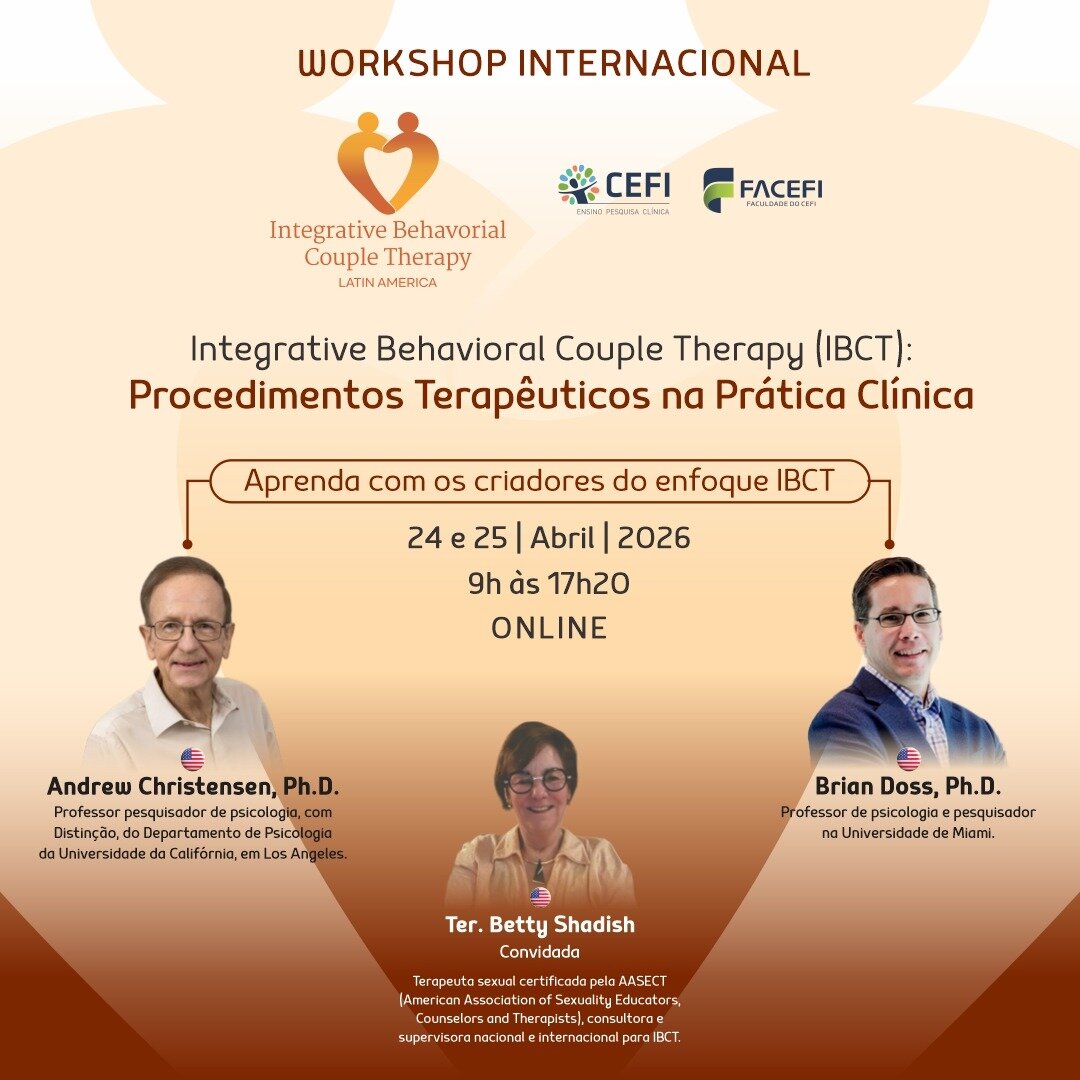

Psychologists, doctors, social workers, health professionals who want to know and improve their skills on marital relationships based on contextual therapies.

16 hours

April 24th and 25th, 2026
Tags: